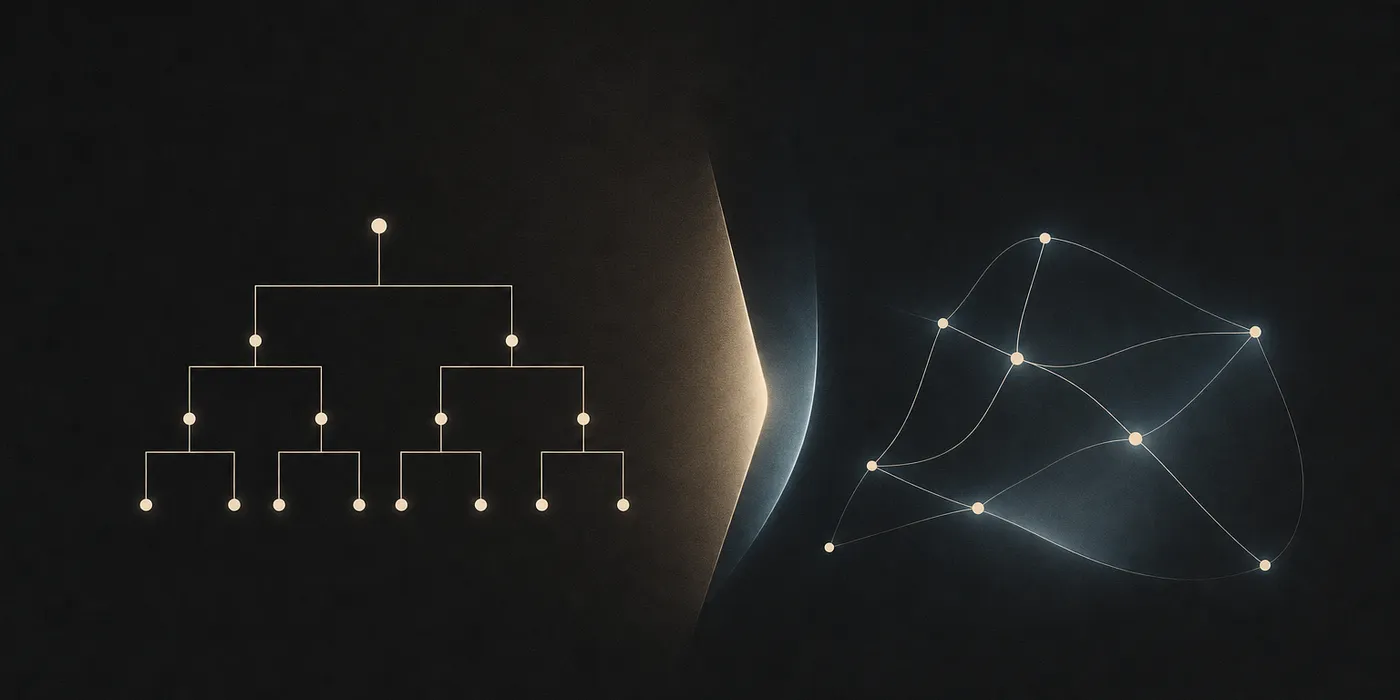
Definition
The Three Trades are the implicit bargain that structured the mid-century corporation as a surrogate village. None were written into employment contracts; they assembled through repetition and hardened, over two or three decades, into what most postwar Americans simply called "a job." The first trade: autonomy for security — workers surrendered the power to decide what, when, where, and how they worked in exchange for near-certain employment, a pension, and stability. The second: craft depth for membership — workers gave up deep domain mastery for organizational belonging, becoming loyal generalists rather than independent masters. The third: local community for institutional protection — workers traded the hyperlocal web of neighbors, church, and extended family for comprehensive, employer-bound benefits.
Read together, the trades explain how a firm with hundreds of thousands of employees could offer genuine belonging and still generate surplus — and why that arrangement carried a fragility now coming due.
The problem it solves
Chapter 1 ends on an identity void: industrialization deleted the software that told people who they were. The guild had answered the identity question automatically; the factory replaced craft identity with a function number and a city of strangers. Something had to fill that void. The Three Trades name how the 20th-century corporation did — not by design or ideology, but through the blunt logic of a problem that needed solving and a surplus large enough to solve it.
As a framework, the Three Trades give leaders a precise inventory of what a job actually exchanged. That inventory is the prerequisite for designing what comes next, because you cannot consciously redesign a bargain whose terms you've never named.
Anatomy
- Autonomy for security. The craftsman owned the power to decide — what to make, when, how, for whom. A master blacksmith's judgment was sovereign within the guild's constraints; nobody told him when to start his forge. The corporation ended this completely, if not suddenly. You worked the hours the company set and went where it sent you. James Fletcher, the composite IBM engineer Chapter 2 follows, didn't choose to leave Endicott, New York in 1961 — IBM chose for him, and he moved three more times before the decade ended. In exchange came near-certain employment, a pension covering 70% of his final salary at retirement, and the social capital of belonging to one of the most recognized institutions on earth. Colleagues who refused transfers were counseled out within months. Harsh, but legible — and it held.
- Craft depth for membership. The guild's gift was mastery that traveled with you, lived in your hands, and defined your worth to anyone who could evaluate it. The corporation offered membership instead. The organization man, as Whyte documented, was a generalist — moved regularly between functions, expected never to become too embedded in any single domain, his value residing not in what he knew but in his loyalty, adaptability, and organizational fluency. Specialization was suspect; it made you hard to relocate, hard to replace, dangerously independent. IBM's dark-suit, white-shirt dress code was doctrine, not vanity: "A man who comes to work in a sloppy suit," Watson Sr. reportedly said, "has a sloppy mind." External uniformity signaled that a man had accepted the terms and been admitted into a community more durable than anything he could build alone in a rented apartment in a city of strangers. For people arriving from disrupted communities and immigrant families with no other pathway to stability, the membership was often worth far more than the mastery traded away.
Figure: The second trade in one image — the corporation offered organizational belonging in place of the craftsman's portable, self-defining mastery, converting masters into loyal generalists.
- Local community for institutional protection. The pre-industrial worker was embedded in a web of local obligation — neighbors who helped during illness, church communities that supported the bereaved, extended families who buffered failed harvests. Unreliable and uneven, but present. The corporation made that web redundant by making it unnecessary. Margaret Chen, who joined AT&T in 1963, remembered the recruiting pitch precisely: "You'll never have to worry about healthcare, retirement, or economic downturns. We take care of our people." AT&T delivered — covering three surgeries for her daughter's congenital heart condition, holding its no-layoff policy through 1970s recessions, sustaining her pension at the standard she'd built. The price: she couldn't leave. Benefits were non-portable, pension credits non-transferable, the insurance covering her daughter's cardiology tied to her employment. The architecture of protection was also the architecture of capture.
Figure: The three trades assembled into a single container called "a job" — autonomy, craft, and community exchanged for security, membership, and protection; the AI-Born transition empties the container faster than any prior rupture.
How it works in practice
Two conditions made the trades economically viable, and Chapter 2 insists on both. First, coordination required human scale: information traveled at the speed of a memo, so a decision passed through seven or eight human layers, and middle management was the only available instrument — Chandler's "visible hand." When you need 40,000 people to show up daily for thirty years and transmit knowledge to the next cohort, the economics of belonging become compelling; the country clubs and pensions were the lubrication a coordination system of that scale required. Second, the surplus was large enough to share: postwar profitability, real median family income nearly doubling between 1947 and 1973, made distribution through wages and benefits a sound business decision rather than charity.
Both conditions were contingent facts, not eternal laws — and both have dissolved. ERP systems automated the information-routing that justified the management layer; the surplus redirected toward shareholders under the doctrine that the corporation existed primarily for them. The AI-Born transition completes the dissolution faster and simultaneously. A 7-person team managing 250,000 enterprise interactions eliminates the coordination problem the large workforce was built to solve — not reduced, eliminated as a category. And when Lovable crosses $400 million in revenue with 146 employees, the surplus concentrates in equity holders and the small team rather than spreading across thousands. The economic logic of the surrogate village — we share the surplus because we need you — is structurally absent.
How to apply it
- Audit your own employment bargain against the three trades. What does your organization ask people to surrender — autonomy, craft depth, local community — and what does it actually provide in return? Naming the exchange exposes which half of each trade is silently breaking.
- Check whether the two enabling conditions still hold. Does coordination still require human scale, or has software absorbed it? Is the surplus large enough to share, or has it concentrated? Where both have eroded, the old bargain is a promise the firm can no longer keep.
- Design the next trade consciously. The factory owners of 1820 had no warning; we do. That difference carries an obligation. Decide deliberately what an AI-Born firm offers in place of security, membership, and protection — rather than defaulting into the unnamed "fourth trade" of autonomy granted, community withdrawn.
- Locate the new answer to the identity question outside the office. The next architecture won't answer "where do I belong?" the way the surrogate village did. Plan for that absence rather than assuming the firm will fill it.
Failure modes / misuse
- Mistaking the trades for villainy. The surrogate village provided something real to real people who had little else — economic security a coal-miner's son couldn't imagine, medical catastrophes survived, dignity in retirement. Reading the trades only as control misses why they held for a century.
- Ignoring the exclusions. The belonging was partial and the guest list was maintained carefully: women barred until the 1960s in places, Black Americans locked out by redlining, union discrimination, and a GI Bill administered to exclude them. A framework that celebrates the trades without naming who was denied them is dishonest.
- Assuming the trades can be restored. They depended on contingent conditions that are gone. The task is not to rebuild the bargain but to design its successor.
Relationship to other frameworks
The Three Trades are the corporation's attempt to rebuild the The Integration Index within the logic of wage labor — and the last credible one. The identity the trades traded on is the subject of Utilitarian Man. Their dissolution is one face of the The Lineage Break: when coordination is automated and surplus concentrates, the bargain's two pillars fall away. And the firm that replaces the surrogate village runs on the Machine Core + Human Cortex architecture, which needs thousands of people for nothing the trades were built to purchase.
Origin note
Original to this manuscript. The framework synthesizes the history of corporate paternalism — Whyte, Drucker, Follett, McGregor, Chandler — into a structure for evaluating what an employment bargain exchanges; the triad is named and developed by the author in Chapter 2.
One of the frameworks running through AI‑Born by Mehran Granfar. Developed across Volume I, "The Machine Core".