Definition
A lineage break is a replacement, not a transformation. It's the moment a new organizational form emerges that shares almost nothing with its predecessor in structure, economics, or operating logic — while sometimes sharing its purpose. The first lineage break was industrialization: pre-industrial craft production didn't evolve into the factory, it was replaced. The second lineage break, underway now, is the shift from the large-workforce enterprise to the AI-Born firm. The word "break" is chosen against softer alternatives. "Transition" implies a change in degree along a continuum. "Shift" implies rebalancing within a stable system. Neither fits. The equations governing the new form are different from the old.
The test for a genuine lineage break is simple: a faster horse is not one, a car is. The car doesn't just do what the horse did more quickly. It changes what transportation means, who builds it, what skills it needs, and what kinds of communities can exist where. The replacement operates across every dimension at once, not just along the speed dimension.
The problem it solves
Leaders confronting AI keep reaching for the wrong analogy. They treat it as a powerful new tool to deploy across existing workflows — the way factory managers in 1890 bolted electric motors onto the same drive shafts that had run on steam, and then waited three decades for productivity that never compounded. Paul David traced that failure to a conceptual error: managers treated electricity as a more powerful steam engine rather than as a technology demanding organizational redesign. The Lineage Break framework exists to prevent the same mistake, translated forward. It tells leaders that what's happening is categorical, not incremental — and that the appropriate response is not deployment but redesign.
It also calibrates urgency correctly. The break is not a coming risk to forecast. It is a present-tense rupture already producing case studies, reversals, and revenue figures that no prior model predicts.
Anatomy
A genuine lineage break shows three signatures:
- Categorical difference. The new form shares the old form's purpose (producing goods, generating revenue) while sharing almost nothing else — not its headcount economics, not its decision architecture, not its organizational logic.
- Apparent absurdity by the old standards. The reliable tell is that the new form seems impossible from inside the old one. When Lovable adds $100 million in revenue with 146 people, the reaction from a traditional organization isn't "impressive efficiency." It's disbelief. These reactions are epistemically appropriate: the new form violates the governing equations of the old.
- Simultaneous disruption of every characteristic. Industrialization didn't make craft production faster; it decomposed the blacksmith's integrated identity into fragmented tasks for interchangeable workers. The large-workforce enterprise of the 20th century had a set of defining characteristics: size correlated with market power, coordination required management layers, revenue scaled roughly with headcount, expertise walked out the door with people, and career progression meant accumulating seniority. The second break disrupts every one of these at once. When agents route information, execute decisions, manage workflows, and coordinate thousands of concurrent processes without a management layer, the organization doesn't get better at being large — it becomes something that doesn't need to be large.
The engine underneath is the category shift from tools to agents. A tool executes your instructions; you remain the operator. An agent operates within constraints you define, pursuing goals you set, without step-by-step direction. That distinction is what separates marginal efficiency from architectural discontinuity.
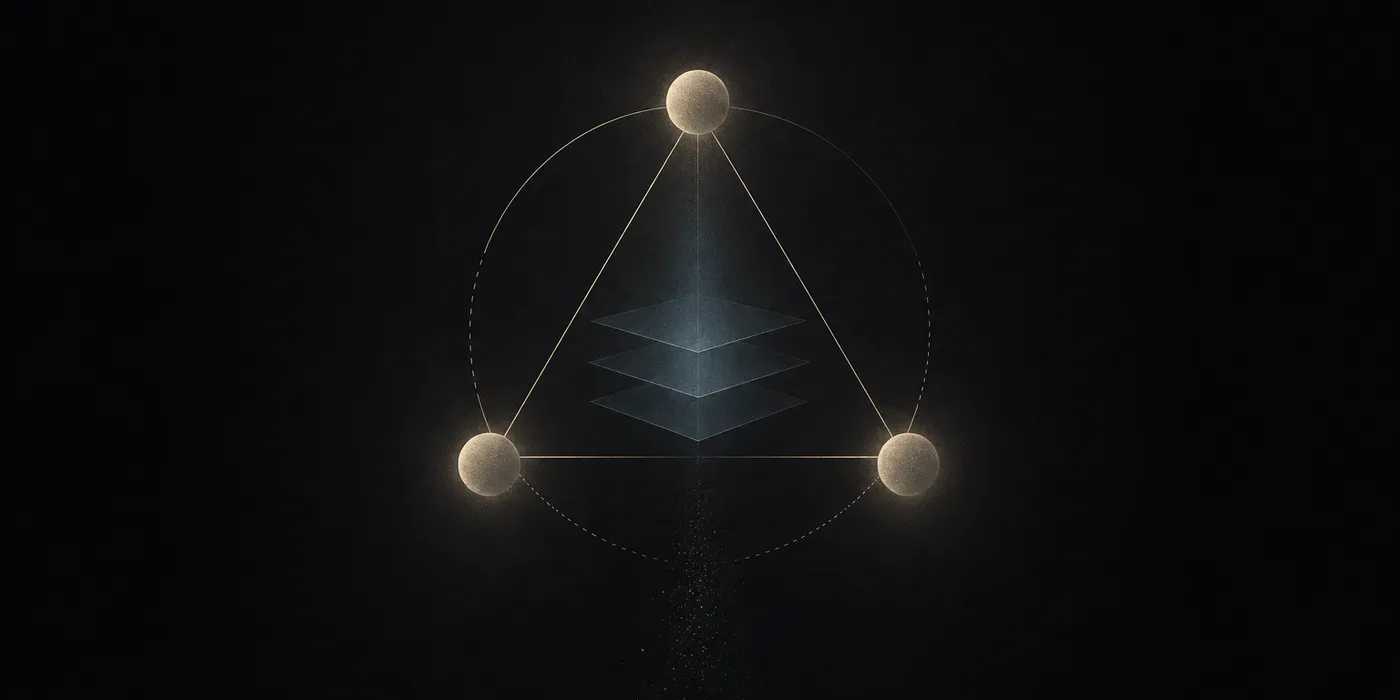
Figure: A lineage break is replacement, not improvement — the new form arrives sharing the old one's purpose while sharing none of its headcount economics, decision architecture, or organizational logic.
How it works in practice
Chapter 3 documents both sides of the break in real time. The old form is visibly contracting through deliberate choices. Klarna ran a public, production-scale experiment — automating customer service, then correcting course when generic responses frustrated customers at fragile-trust moments — and the market valued the corrected hybrid model at IPO. Shopify's Tobi Lütke made human hiring the exception, requiring managers to prove a role couldn't be done by AI first. Block cut roughly 40% of its workforce and published a theory with it: corporate hierarchy exists to route information, AI can now do that, so the middle layers dissolve. IBM ran the full cycle — freeze, restructuring, then a reversal toward tripled entry-level hiring — discovering a new scarcity in humans who could architect and govern the systems that replaced the old coordination layer.
A Swedish fintech, a Canadian commerce platform, an American payments company, and a century-old enterprise-tech firm — different regulatory environments, different customer relationships, different founding stories — arrived at structurally similar conclusions about what their organizations look like on the other side. That convergence is the evidence the pattern is structural, not four isolated experiments. And the choices were rewarded by capital, not punished: Klarna opened at $52 against a $40 issue price; Block's stock rose 22% after its restructuring announcement, with Dorsey targeting $2 million in gross profit per employee. The market was not punishing the architecture. It was pricing it. Meanwhile the new form already exists and operates — the cohort of the The Small-Team Paradox, where revenue grows while headcount is held deliberately small because adding humans to an agent-first architecture creates coordination overhead that adding compute does not.
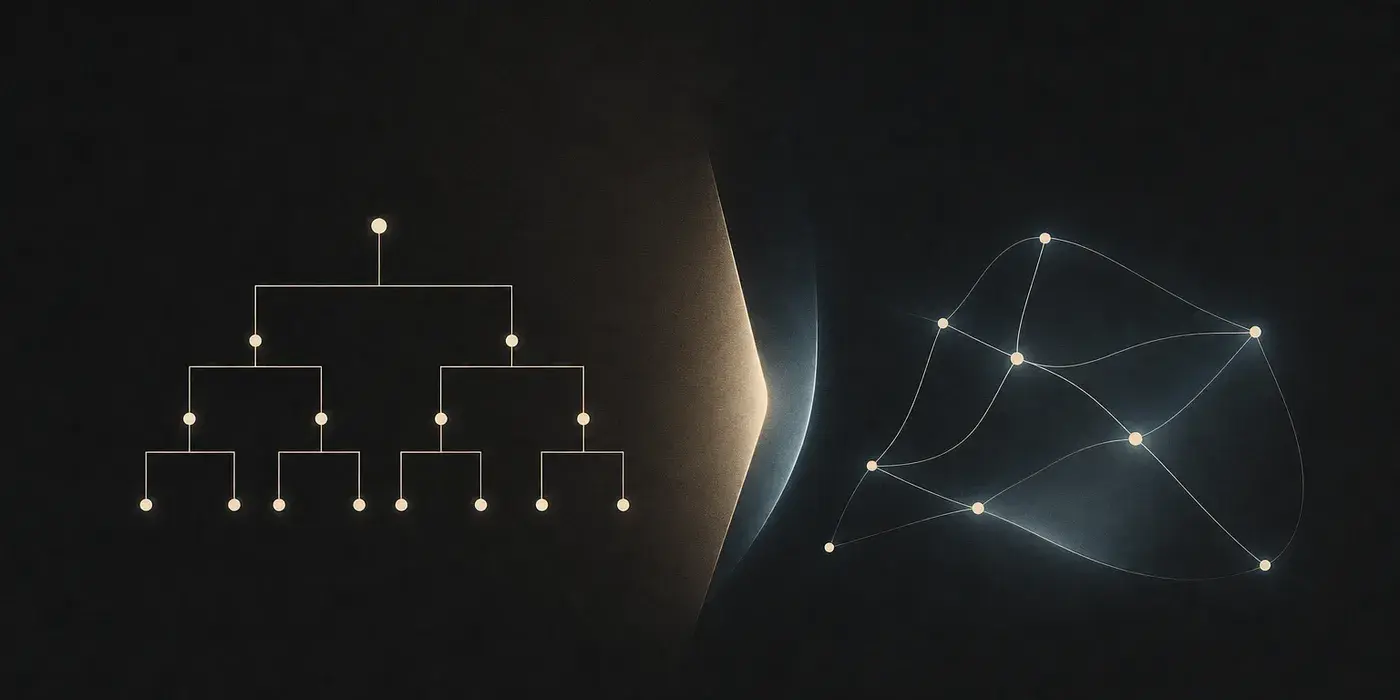
Figure: The break is a discontinuity, not a steeper slope — and this time the lag between rupture and reorganization compresses, because the new form is supplying the very tools that accelerate everyone else's transition.
This time the transition moves faster than prior ruptures. Edison unveiled the incandescent bulb in 1879; twenty-one years later, fewer than 5% of American homes had electricity, and productivity barely moved for three decades while managers bolted electric motors onto steam-era drive shafts. E-commerce took about fifteen years from the mid-1990s to become the dominant retail model. The gap exists because organizational transformation needs new mental models, management practices, talent pipelines, and legal frameworks — and organizations change slowly.
The AI-Born transition compresses that lag for two structural reasons prior ruptures lacked. First, the most credible articulators of the break are inside the establishment, not attacking it from outside. Dorsey runs the experiment at a company processing trillions in annual transactions and publishes his conclusions in real time; Lütke sets explicit hiring policy at a platform managing millions of merchants; Dimon — at the largest U.S. bank, with over $2 billion invested in AI — warns from the center of the system that firm-level rationality and system-level stability are not automatically aligned. Second, the cohort is itself supplying the tools that accelerate the transition for everyone else: Cursor speeds software development for millions of engineers, Perplexity speeds information retrieval across industries, Lovable lets non-engineers build applications in natural language. Steam engines didn't build better steam engines. The internet didn't build a faster internet. The new form is both demonstrating the transition and catalyzing it.
How to apply it
- Diagnose which kind of change you face. Ask whether the proposed move changes a quantity (faster, cheaper, more) or a category (different equations entirely). If it's only quantity, you're optimizing the old form. If it's category, you need a new architecture.
- Audit for "electric motors on steam-era pulleys." Where have you deployed AI onto unchanged workflows and hierarchies? Those are the deployments most likely to plateau at marginal gains — the pattern behind the large share of enterprise AI pilots that delivered no measurable P&L impact.
- Watch for the absurdity signal. When a competitor's results seem impossible by your standards, don't dismiss them. Treat the disbelief as a diagnostic that a break has occurred and your governing equations no longer apply.
- Calibrate urgency to the present. Build toward the new architecture as a competitive response to companies already in market and already winning on a cost-and-speed advantage rooted in architecture — not as a hedge against a speculative future.
Failure modes / misuse
- Confusing a break with disruption. Disruption can be ordinary competition. A lineage break replaces the form. Calling every change a "lineage break" empties the term; reserve it for categorical replacement.
- Over-reading the timeline. The framework establishes that the rupture is present-tense and real. It does not claim the displacement is total, complete, or uniform across sectors with different regulatory environments and capital requirements. The direction isn't in question; the completion date is.
- Treating the new form as fully understood. What's proven is that the old form is ending and the new form exists. What remains genuinely open is the internal architecture that makes the new form stable, governable, and reproducible. That's the setup for the rest of Book 1, not a solved problem.
Relationship to other frameworks
The Lineage Break is the historical and diagnostic frame; the The Small-Team Paradox is its measured present-tense evidence. The break is realized only by firms built [[ai-enabled-vs-ai-born|AI-Born]] rather than AI-enabled — the tools-to-agents category shift is the engine. Its internal resolution is Machine Core + Human Cortex, the two-organ architecture Part II develops. And it rhymes with the first break analyzed through the The Integration Index: a rupture that creates abundance while severing what the old form sustained.
Origin note
Original to this manuscript. The concept of a civilizational "lineage break" frames the AI transition as a rupture on the order of the Agricultural and Industrial Revolutions; the second-break analysis and its company cases are developed in Chapter 3.
One of the frameworks running through AI‑Born by Mehran Granfar. Developed across Volume I, "The Machine Core".