Definition
The New Triumvirate is the set of three human roles that constitute the [[machine-core-human-cortex|Human Cortex]] of an AI-Born enterprise: the Architect, who sets strategic intent and designs the cognitive architecture that executes it; the Guardian, who keeps judgment, arbitrating the edge cases where the system's rules run out; and the Force Multiplier, who transmits taste by doing the work alongside others, multiplying team capacity through craft rather than management. Three roles survive every wave of automation — not because AI is incapable of complexity, but because they require accountability, cultural embeddedness, and judgment that accumulates through sustained consequence.
Why it exists / the problem it solves
When the [[machine-core-human-cortex|Machine Core]] absorbs execution, coordination, and routine cognition, the question becomes: what is left for humans, and why exactly that? The Triumvirate answers it with two arguments held at once.
The first is capability: today, AI cannot set worthy ends, sense when the rules themselves need revision, or exercise cultural foresight. But this argument is time-bounded — AI is improving at precisely these tasks. The second argument is the load-bearing one because it survives any advance in AI capability: democratic accountability, market legitimacy, and the social contract require human agents who can be named, questioned, and held responsible. Courts need defendants, not systems. Stakeholders need people, not processes. Regulators need accountability chains that trace back to specific human decisions. Build the Triumvirate for both reasons, but treat the accountability argument as the foundation.
Anatomy
The Architect — Intent-Setter and Systems Designer. Think of a composer who never touches an instrument: every measure, played by thousands of agents at once, expresses a structure she designed before a note sounded. The Architect does two things no agent can do together — she sets strategic intent (choosing which objectives merit optimization) and designs the cognitive architecture that executes it. Technology magnifies intent but never originates purpose; AI optimizes a defined objective function but cannot ask why this, and not something better? Her competencies pair Technical-Organizational Design (finding the leverage points where a single change ripples through five layers, then turning governance intent into [[agent-charters|charters]], permission boundaries, and escalation protocols) with Values-Conscious Orchestration (designing handoff protocols, feedback loops, and participatory processes that surface stakeholder values before encoding them).
The Guardian — Judgment-Keeper. The Guardian is the last human in the loop before the world sees the work, and the first to ask whether the work serves the right ends. When agent swarms escalate ambiguous, high-stakes, or ethically charged decisions, the Guardian makes the call — judging alignment with purpose, not merely output quality. The role runs on three operating procedures: mandatory escalation categories (irreversibility, novelty, stakeholder impact, values conflict, regulatory ambiguity), four available responses (approval, approval with modifications, deferral, veto — each logged with timestamp and reasoning), and five monitoring metrics (override rate, escalation-rate trend, charter-amendment backlog, Trust Velocity, and a weekly random audit of 5–10 non-escalated decisions to catch the slow drift that crosses no single line). The Guardian's structural independence is part of the design: no P&L responsibility, no reporting line to the CEO, and explicit authority to raise values concerns without executive override.
The Force Multiplier — Taste-Transmitter and Player-Coach. When execution commoditizes, differentiation shifts to what agents cannot replicate, and taste becomes a moat. The Force Multiplier holds that moat. She does not manage; she does the work alongside others, transmitting craft through example. Her three practices form a closed loop: Taste Training (working with the Architect to build evaluator agents trained on curated examples, scaling judgment at machine speed), Escalation Review (reviewing flagged decisions, each one becoming training data, with random audits of auto-approved outputs), and Team Capacity Building (developing the humans around her through doing, so her standards outlast her presence). Her real product is not the fix she ships but the team that can build the next one without her.
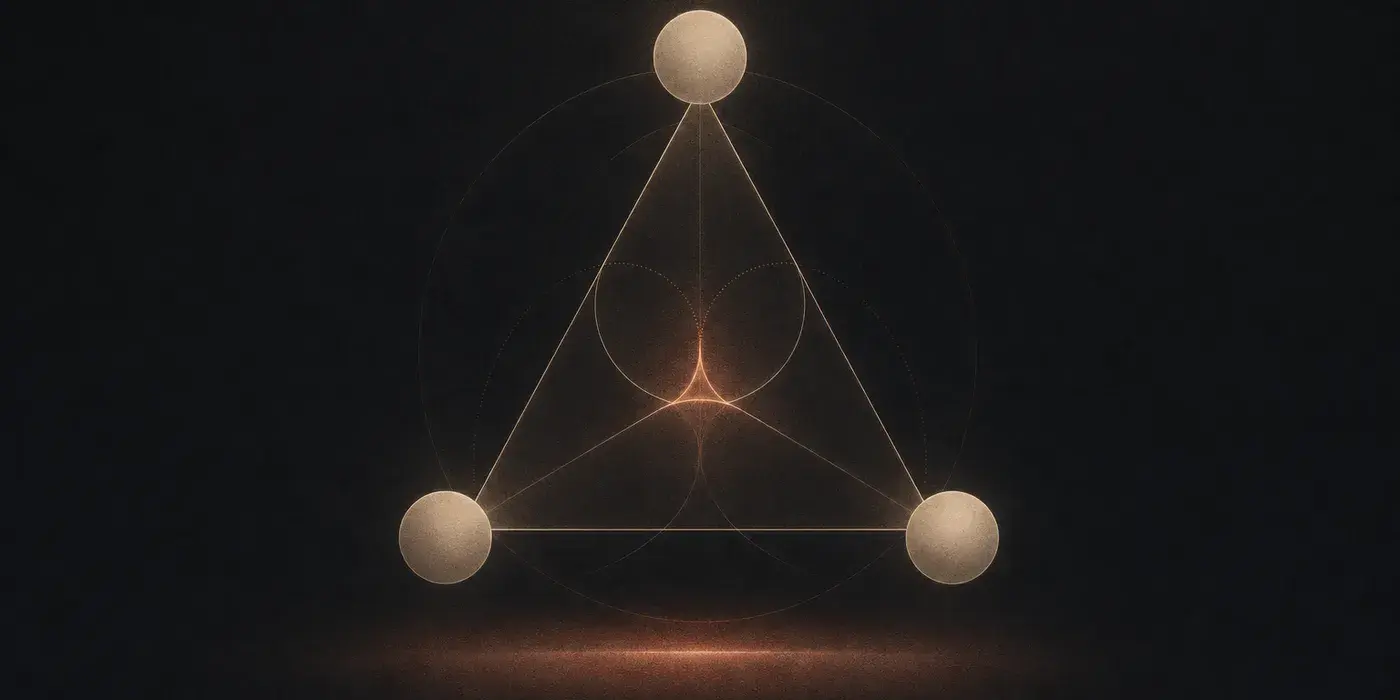
Figure: The three irreducibly human roles. The Architect sets intent and designs the system, the Guardian holds judgment at the edge cases, and the Force Multiplier transmits taste by doing the work — each distinct, yet every real intervention drawing on all three.
How it works in practice
Chapter 9 runs three composite scenarios at Aether Dynamics and adjacent firms. Aria Chen (Architect) opens her dashboard to 847 escalations and recognizes concentrated uncertainty rather than malfunction — route-optimization agents correctly flagging regulatory gray zones and deferring to human judgment as designed. Rather than adjudicate each case (which would bottleneck the firm on her judgment and teach the agents nothing), she encodes an architectural principle — in regulatory ambiguity, default to the conservative interpretation — as a hard constraint, then spawns a regulatory-ambiguity sub-swarm that gives the firm advance warning. That is the Architect's craft: not solving problems but designing conditions where whole categories of problems cannot arise.
Kenji Tanaka (Guardian) receives a rigorous agent recommendation to pivot a rural solar-microgrid company toward more profitable peri-urban deployment. The numbers are real; so is the mission to serve communities no conventional provider would touch. He refuses the binary, designing a cross-subsidy model — peri-urban operations fund rural access at a controlled loss — and encodes it through the [[ipre-pipeline|IPRE Pipeline]] as dual agent swarms with different optimization functions. The Guardian's craft is holding the space where survival and purpose can both be heard, then designing a path where survival depends on purpose.
Sofia Marchetti (Force Multiplier) senses aesthetic staleness in a fashion platform's recommendations even as the metrics celebrate record approval — the agents had found a local maximum and doubled down. She injects randomness, commissions a staleness detector, and reframes the optimization target toward customers developing aesthetic range. Crucially, she brings two junior stylists into the process and narrates her judgment in real time, so they internalize what no training document could convey. That pedagogy — transmitting taste through collaborative doing — is the function that survives even if AI learns to exercise taste.
A working CEO arrived at the same three categories from the opposite direction. In February 2026 Jack Dorsey cut roughly 4,000 employees from Block — about 40% of the workforce — and, with Sequoia's Roelof Botha, codified the theory in "From Hierarchy to Intelligence." Block's three surviving roles map onto the Triumvirate: Individual Contributors and Player-Coaches (Force Multiplier function), Directly Responsible Individuals owning cross-cutting outcomes for defined periods (Architect), with the regulated-finance accountability Dorsey acknowledges AI "cannot lead in" standing in for the Guardian. Two independent analyses — one from first principles, one from running a public company through the transition — yielded the same three categories.
How to apply it
- Name the three roles for your unit — who is Architect, Guardian, Force Multiplier — rather than mapping them onto legacy titles. The roles are functions, not seats.
- Give the Architect leverage, not tickets. Measure her by the categories of problem she designs out of existence, not by the individual fires she fights.
- Make the Guardian structurally independent. No P&L, no CEO reporting line, explicit authority to escalate without consequence. Independence is institutional design, not job description.
- Build the Force Multiplier as a first-class function, not an afterthought. Resource taste transmission and team capacity building deliberately; this is where [[taste-as-a-moat|Taste as a Moat]] is actually held.
- Engineer the psychological architecture. The roles carry real risks — isolation in crowds of agents, the flattening effect (taste converging toward the agents'), context-switching overload. The mitigations are architectural (protected synchronization time, quarterly rotation through non-AI environments with recalibration triggers, escalation caps and batching), not wellness programs.
Figure: The hidden cost of the cortex. Directing crowds of agents carries distinct psychological risks; the Triumvirate treats them as design problems with structural mitigations, not as matters for wellness programs.
Failure modes / misuse
- Mapping the roles onto old titles. Treating the Architect as "the CTO" or the Guardian as "compliance" reimports the hierarchy the cortex is meant to replace.
- A Guardian inside the chain of command. Financial pressure and values judgment are incompatible over time; a Guardian with P&L or a CEO reporting line cannot do the job.
- The flattening effect. Force Multiplier rejection rates that fall from 50% to under 10% over six months signal taste convergence, not skill — the distinctiveness the role exists to preserve eroding while metrics stay green. Track it; recalibrate below 12%.
- Oligarchy. Three people with concentrated authority and no transcendent shared purpose is a governance crisis awaiting a trigger (as Roman triumvirates demonstrated). Mitigate with structural arbitration, sharp domain boundaries, joint accountability, and documented succession.
- Cortex doing Core work. A Triumvirate that adjudicates cases instead of designing systems re-creates the coordination tax it was meant to dissolve.
Relationship to other frameworks
The New Triumvirate is the structure of the [[machine-core-human-cortex|Human Cortex]] — the judgment layer above the Machine Core. The Architect authors [[strategy-as-code|Strategy-as-Code]] and the [[agent-charters|Agent Charters]] that bound the [[vp-agent-architecture|VP-Agents]]; the Guardian sits at the interface between the governance loop and the Cortex, resolving the escalations agents raise and proposing charter amendments; the Force Multiplier holds [[taste-as-a-moat|Taste as a Moat]] and scales it through evaluator agents. All three exercise [[values-conscious-architecture|Values-Conscious Architecture]] — the recognition that every design choice embeds moral commitments. Each role remains distinct, yet the Chapter 9 scenarios show every real intervention requiring all three.
Origin note
ROLES ORIGINAL. The three specific roles (Architect, Guardian, Force Multiplier) and their AI-era framing are original to this manuscript. The word "triumvirate" denotes a three-person leadership structure with precedent in healthcare and other organizational contexts; the originality lies in the role definitions, not in the count of three. (Earlier internal drafts named the third role "Intent-Setter"; the canonical Book 1, Chapter 9 roles are Architect, Guardian, and Force Multiplier, with intent-setting folded into the Architect's mandate.)
One of the frameworks running through AI‑Born by Mehran Granfar. Developed across Volume I, "The Machine Core".