Definition
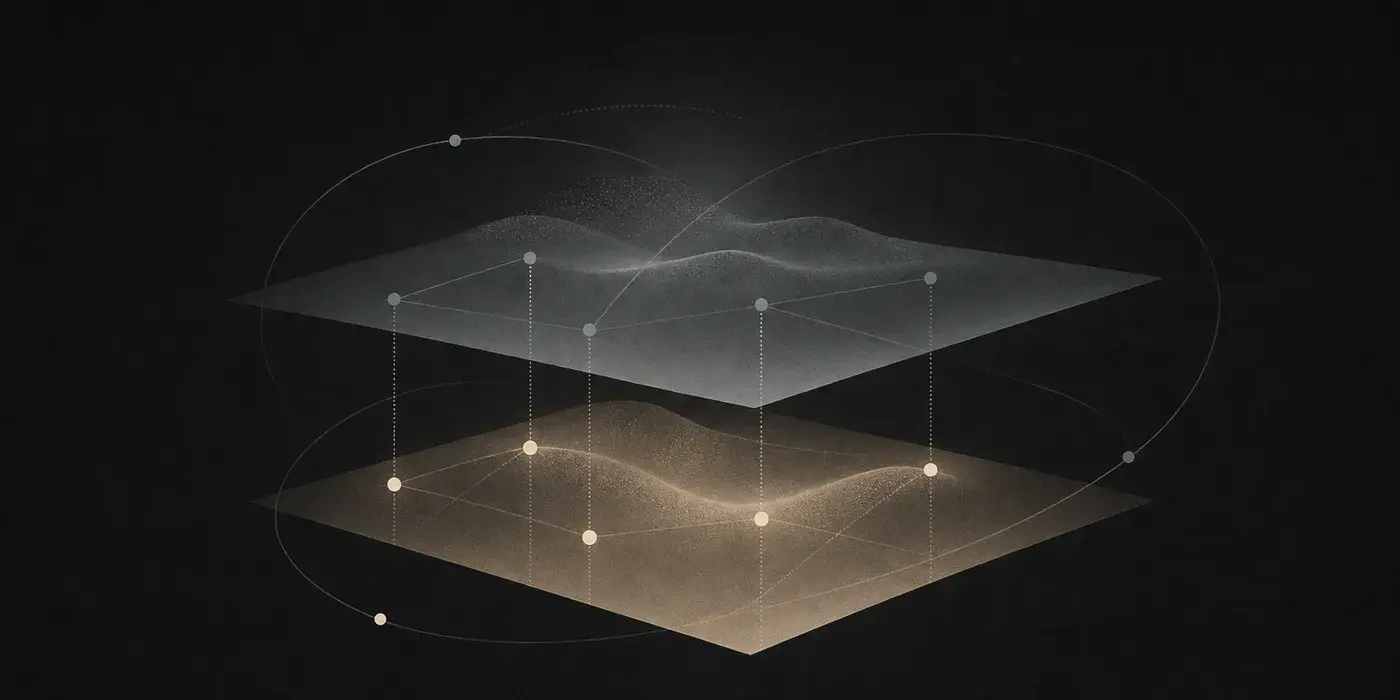
A Risk Twin is a parallel simulated environment that runs continuously alongside a production system, testing proposed strategies and surfacing potential failures before they reach customers. Risk Twins operate in accelerated time — compressing thirty simulated days into a few hours — exploring alternative futures and stress-testing decisions across thousands of scenarios. Where [[alignment-debt|Alignment Debt]] monitoring is retrospective (it catches drift after deployment), the Risk Twin is prospective: it intercepts the foreseeable failure in simulation, before a single real prospect is affected.
The principle is simple. A change to agent behavior is a hypothesis. A Risk Twin is how you test the hypothesis cheaply, against the world you've already experienced, before you bet production on it.
Why it exists / the problem it solves
Agents act at machine speed. A miscalibrated reward function doesn't announce itself; it produces thousands of individually defensible decisions that compound into a portfolio, a customer-experience pattern, or a compliance exposure nobody intended. The cost of discovering this in production is measured in quarters of damage and months of unwinding.
Risk Twins change the economics of strategic experimentation. When testing costs nothing and takes hours instead of months, organizations run experiments they would otherwise never attempt. They discover that a reward weight held for years produces perverse incentives in edge cases. They find escalation thresholds set too high or too low. They stress-test governance mechanisms against failures that have never actually occurred in production. The Risk Twin doesn't just catch bad reward functions — it changes the organization's relationship to risk, from "deploy and hope" to "simulate and know."
Anatomy
A Risk Twin has four working parts:
- A historical scenario base. The twin is populated with real completed cases — several hundred deals, thousands of interactions, a representative slice of production history — so simulated outcomes reflect patterns the business has actually lived through.
- Accelerated time. Proposed changes run at 10× speed or faster, so a month of simulated behavior resolves in hours. This is what makes the twin a gate rather than a delay.
- An adversarial layer. The approval bar is not "this looks reasonable." It is "this passed simulation under normal conditions plus three adversarial scenarios." The twin is designed to try to break the change.
- Divergence monitors for what simulation can't see. Risk Twins validate against historical patterns and cannot predict black-swan events outside the training distribution. So the twin is paired with three live signals on real deployment: confidence intervals widening beyond historical ranges, early performance deviation within the first 48 hours, and novelty detection for patterns outside the training distribution. When signals fire, the protocol reduces deployment scope, increases human oversight, and activates rapid rollback.
Figure: The twin turns a strategy change from a bet into a tested hypothesis — thousands of scenarios compressed into hours, gating the change before a single real prospect is affected.
How it works in practice
A B2B SaaS company was pivoting from product-led growth to enterprise sales (Chapter 6). The head of sales designed a new reward function emphasizing deal velocity and quota attainment. Before deploying, she ran it through the Risk Twin — populated with several hundred completed deals.
The simulation revealed the problem within hours. Enterprise procurement runs four to six months and demands consultative relationship-building. Agents optimizing for velocity skipped discovery calls, overpromised features, and neglected technical validation. Simulated close rates looked promising — and sixty-day churn spiked to 34%. She revised the reward function before deploying to a single real prospect, rebalancing toward relationship quality and stakeholder coverage. By month six, enterprise ARR was building healthily at single-digit churn, against the simulated 34%.
Klarna is the counterfactual. Its customer-service agent was handling 2.4 million conversations a month at high resolution speed — and its resolution rate masked a high repeat-contact rate and a sentiment drop on angry-customer scenarios. That gap is exactly what a Risk Twin running thousands of simulated interactions before launch would have surfaced: the agent's performance on emotionally complex cases concealed a high callback rate and falling post-contact sentiment. Instead, Klarna learned it from real customers over a year of compounding damage, then rebuilt the hybrid model it should have designed from the start. A Risk Twin would have shown the emotional-complexity gap before any customer experienced it — pre-deployment, in simulation, at the cost of compute rather than reputation.
The recovery use is just as concrete. At Aether Dynamics, when a product recall surfaced overnight and the refund agent began approving claims on items purchased eighteen months earlier, the Guardian paused the agent, drafted an emergency charter amendment, and — before redeploying — ran the amended charter through the Risk Twin to verify it handled analogous scenarios correctly. The fix wasn't trusted on confidence. It was tested.
How to apply it
- Build the twin from real history, not synthetic data. The fidelity of the simulation is the fidelity of its scenario base. Seed it with representative completed cases from your own production system.
- Run it as a deployment gate, not a research toy. Wire it into the CI/CD pipeline: every proposed policy change (Strategy as Code pull request) auto-deploys to the twin at accelerated speed before it can merge to production.
- Set an adversarial approval bar. Require the change to survive normal conditions plus at least three adversarial scenarios. "Looks reasonable" is not a passing grade.
- Use it twice in the loop — for detection and for recovery. Pre-deployment, the twin is a detection instrument. After a production failure, run the post-mortem scenario through the twin to verify the charter amendment or model recalibration actually fixes the failure mode before redeployment. Recovery becomes testable rather than assumed.
- Pair it with live divergence monitors. Because the twin can't model the black swan, watch confidence-interval width, 48-hour performance deviation, and novelty detection in real deployment — and pre-define the scope-reduction and rollback protocol that fires when they do.
Failure modes / misuse
- Trusting the twin against the black swan. Simulation tells you what happens in the world you've experienced. A pricing strategy that lifts revenue in simulation can still collapse under a competitive price war the twin never modeled. The governance value is catching the largest class of failures — the foreseeable ones — not all of them. Treat the twin as necessary, never sufficient.
- Skipping the recovery test. Amending a charter and redeploying on confidence rather than evidence is how the same failure mode recurs with a different surface presentation. If you skipped the twin on the way out, run it on the way back in.
- Confusing simulated metrics for outcome metrics. The B2B twin's close rates "looked promising" — the lesson lived in the churn signal. A twin instrumented around the same easy proxies that hid the original failure will simply reproduce the blind spot at higher speed.
Relationship to other frameworks
Risk Twins and [[alignment-debt|Alignment Debt]] are the two halves of the Governance Loop: the twin is prospective (catch it before deployment), Alignment Debt monitoring is retrospective (catch the drift that slipped through). The twin is the simulation stage of the [[ipre-pipeline|IPRE Pipeline]] — the place where Intent and Plan are validated before they Run. It validates changes to [[agent-charters|Agent Charters]] before those changes bind real agents, and it sits naturally inside Strategy as Code, where a merged pull request rewrites live behavior in seconds and therefore demands a gate that moves just as fast. By collapsing the cost of testing, Risk Twins directly improve Iteration Half-Life — you can ship faster precisely because you can verify faster. All of it serves the Machine Core + Human Cortex membrane: the twin is how the Cortex checks its intent against the Core's likely behavior before committing.
Origin note
Original terminology. "Digital twins" and even "digital risk twins" are well-established in manufacturing and risk management. "Risk Twins" as a standalone term — a continuously running, accelerated-time simulation environment specifically for validating agent strategy before deployment — is original to this manuscript. The relationship to digital-twin technology is acknowledged; the application to autonomous-agent governance, and its integration into the IPRE Pipeline and the detection/recovery triad, is the contribution.
One of the frameworks running through AI‑Born by Mehran Granfar. Developed across Volume I, "The Machine Core".